
The CPG Survival Playbook: How Natalia Glushchenko Helps Brands Balance Margin and Loyalty

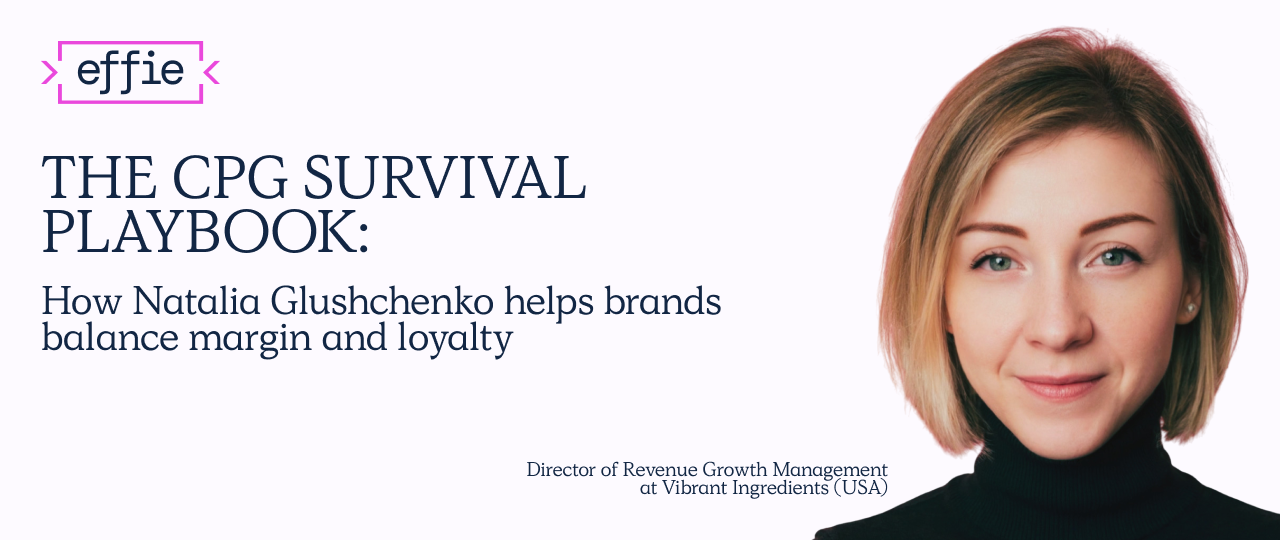
We met Natalia Glushchenko, Director of Revenue Growth Management at Vibrant Ingredients (USA), formerly with Danone, JDE Peet’s, AB InBev, and Nestlé, during the EPP Revenue Growth Management Forum America 2025 — an event that brought together FMCG leaders from across the globe.
Her talk, “Thriving Under Pressure: Adaptive Strategies for Volatile Times,” quickly became one of the most discussed sessions at the forum, as brands everywhere are searching for ways not just to survive in a turbulent economy, but to grow despite instability.
After the conference, we continued our conversation with Natalia to explore how companies can balance profitability with consumer trust. In this article, we share the key takeaways from her presentation — along with real examples of how modern FMCG players are adapting to the new reality.

When Stability Disappears: How FMCG Brands Search for New Rules of the Game
The fast-moving consumer goods (FMCG) world has been living in turbulence for several years. The pandemic, inflationary waves, supply disruptions, rising production costs, and changing consumer habits have forced companies to rethink what once seemed stable.
Today, more than 60%* of consumers in North America and Europe are seeking discounts or switching to private labels. At the same time, they expect transparency and value, forcing brands to balance between profit and trust.
*According to NielsenIQ “Private Label Report”.
We all got used to thinking that it’s enough to just raise prices at the inflation rate. But today, consumers vote not only with their wallets but also with their trust. And losing it is much easier than regaining it.
— Natalia Glushchenko
Walking the Tightrope: How to Stay Profitable Without Losing Trust
When markets fluctuate, companies’ main task is to find a balance between margin and sales volume. Raising prices may improve profitability but often leads to loss of market share. Lowering them may drive volume but undermines the perceived value of the brand.
In one international company, a volume-first strategy was chosen: prices were increased only by 1–2%, while competitors raised them by 5–9%. This helped avoid a sharp volume decline and maintain consumer loyalty.
Sometimes less is more. We kept our shoppers because we respected their price sensitivity.
— Natalia Glushchenko
Another company tested a razor-and-blades model: selling the core product at minimal margin initially but earning on repeat purchases and subscriptions. This strategy required courage — to sacrifice short-term profit for long-term loyalty— but ultimately brought stability.
Every business has its own survival formula. The key is understanding what your consumer values today — and staying agile. Flexibility has become the new strategic discipline.
— Natalia Glushchenko
Preserving Margin and Trust: What Works Today
One of the most controversial tools in recent years has been shrinkflation — reducing product size while keeping the same price. Success or failure here depends entirely on communication.
One company spent a year on research and improved its product formula: it added more active ingredients, enhanced texture, and introduced more sustainable packaging. Although package weight decreased by 9%, consumers perceived the change positively because they saw a real quality improvement. EBITDA remained stable, and loyalty stayed strong.
The problem isn’t that we shrink the product — it’s that we don’t explain what the customer is paying for.
— Natalia Glushchenko
Another example is a large-scale efficiency program — from logistics optimization to portfolio rationalization. It helped reduce costs by 15–20% without touching formulation or consumer experience.
A premium brand achieved a 2–4% margin improvement by optimizing processes and smarter workforce planning — without any compromise on quality.
The real strength of RGM is the ability to cut fat, not muscle. We look for efficiency in processes without questioning product quality.
— Natalia Glushchenko
Five Levers of Adaptive Revenue Growth Management from Natalia Glushchenko
Modern Revenue Growth Management (RGM) goes far beyond pricing. It’s a system of five interconnected levers that help brands navigate volatility:
- Consumer Focus — deeply understanding what drives perceived value.
- Integrated RGM — aligning pricing, promotions, assortment, and trade investment.
- Data & Adaptability — making real-time, data-driven decisions.
- Value Innovation — creating new forms of value that consumers are willing to pay for.
- Operational Discipline — driving efficiency without eroding quality.
Analysts project that by 2026, over 40% of FMCG companies will adopt dynamic pricing algorithms, boosting topline growth by 2–7% while cutting promotional spend by 10–15%.
Conclusion: Thriving Under Pressure
Modern profit management isn’t about formulas or luck — it’s about balancing profitability with trust, analytics with humanity. The brands that survive market shocks are those that see disruption not as a threat, but as an opportunity.
We live in an era where stability is gone for good. But that’s not a reason for fear — it’s a call to build systems that withstand pressure. The strongest aren’t the biggest; they’re the most adaptive.
— Natalia Glushchenko
Today, brands need not just data but connections between data points. That’s where new-generation platforms like effie come in — bridging the strategic vision of manufacturers with the operational reality of retail. They show how decisions made in Excel play out at the shelf and enable timely course corrections. With such tools, companies can act systematically rather than intuitively — preserving margins even when the market changes every day.
Less guesswork — more insight. Less chaos — more predictability.
That’s what modern, practical RGM looks like.
Related

AI Merchandising Agent vs. AI Image Recognition

Overview of CAGNY 2026