
Retail Execution Audit Checklist 2026


In today’s complex and fast-moving retail environment, in-store performance has a direct impact on business results. A well-structured execution audit approach helps companies align strategy with what actually happens in stores — from on-shelf availability and merchandising to standards compliance and customer experience.
This article examines how the retail audit model is evolving in 2026, why traditional checklists no longer meet business needs, and how they should be redefined as a tool for operational excellence.
Why Execution Audits Matter for Business Performance
In-store performance directly impacts the key metrics of retail and CPG companies — sales, promotional effectiveness, product availability, and return on merchandising investments. Even minor gaps, from out-of-stocks to planogram non-compliance, scale across retail networks and result in material losses.
Execution audits enable organizations to see how strategic plans actually perform in real store conditions — and why even well-designed assortment or promotional strategies often fail to deliver expected on-shelf outcomes.
For leadership and operations teams, audits provide objective visibility into how standards perform in real conditions: which SKUs are missing, where shelf execution breaks down, how promotions are implemented, and how consistent the customer experience is across locations. Without this visibility, performance management becomes assumption-driven rather than data-driven.
At scale, execution becomes a strategy multiplier: without consistent in-store performance, even the strongest commercial plans fail to deliver ROI.
Why Traditional Audit Models No Longer Work
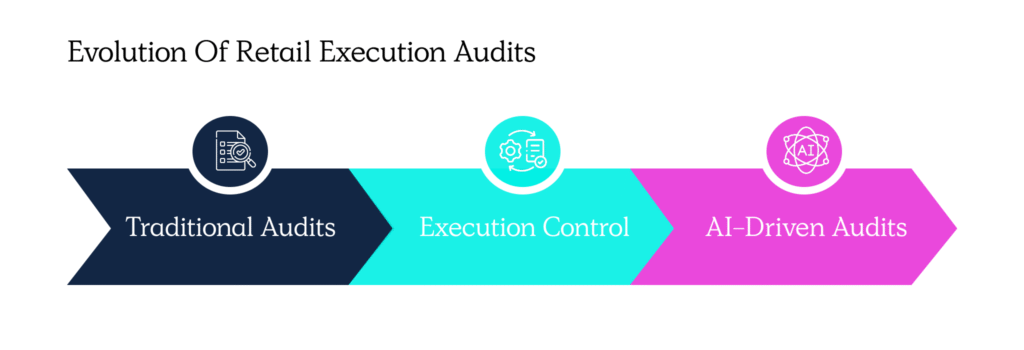
Conventional audit approaches were developed in a far simpler retail environment. Fewer SKUs, longer promotional cycles, and more stable field teams made periodic, manual audits sufficient. In that context, audits primarily served a compliance function rather than an operational management role.
Today, these models increasingly fall short. Data is collected with delays, analysis happens too late, and shelf issues are identified only after they have already impacted sales. Store photos accumulate as proof of execution, but rarely convert into structured, actionable insights.
Human dependency further limits effectiveness. Subjective assessments, inconsistent skill levels across field teams, and high turnover lead to uneven audit quality. As a result, traditional audits document deviations but lack the speed, scalability, and accuracy required to manage performance across large retail networks.
New Requirements for Execution Control in 2026
Execution control must now serve a fundamentally different purpose. Rather than periodic compliance checks, it needs to function as a continuous performance management mechanism embedded into daily operations. Audits become part of the operating cycle, not isolated control events.
Modern approaches shift the focus from fact-finding to decision support and action enablement. Store-level data must be timely, standardized, and usable at both HQ and field levels. What matters most is the ability to quickly identify deviations, prioritize issues, and shorten the time between detection and corrective action.
Retail Execution Audit Checklist 2026: Core Components
In 2026, an execution checklist is no longer a simple list of checks. It is a structured framework that integrates control, analytics, and action. A modern checklist typically covers several dimensions that directly influence business outcomes:
- Availability and on-shelf presence.
Actual SKU availability and prevention of out-of-stock.
- Merchandising and planogram compliance.
Adherence to planograms, correct facings, and category placement.
- Promotional and pricing execution.
Accurate implementation of promotions and pricing conditions.
- Trade equipment and POSM.
Condition and presence of in-store equipment and POS materials that drive brand visibility.
- Execution KPIs.
Quantifiable metrics that enable store comparisons and track in-store performance over time — not just point-in-time compliance.
The Role of AI Agents in Modern Retail Audits
AI is moving beyond task automation toward a model built on AI agents — products that take on operational roles in store performance management. These agents do more than analyze data: they interpret shelf conditions and translate insights into concrete actions.
AI agents continuously process in-store data, automatically detect deviations from standards, and generate context-aware, prioritized recommendations for field teams. In this model, audits are no longer a discrete inspection step but part of a continuous performance management loop.
This approach sits at the core of effie’s products, where AI agents are designed to take on specific operational roles — from shelf recognition and execution analysis to guided actions and performance control — all within a single operating model.
Conclusion
Execution audits are evolving from a formal control mechanism into a driver of operational excellence and strategic scalability. Companies that combine objective in-store data, faster decision-making, and scalable execution gain a sustainable competitive advantage at the shelf.
If you are rethinking how store performance is managed across your retail network and looking to turn audits into a growth lever, contact the effie.ai team at sales@effie.ai. We would be happy to discuss how a modern execution approach can support your business objectives.
Related

Effie.ai Launches AI Perfect Store Agent for Real-Time Retail Execution

Effie.ai Joins the Promotion Optimization Institute (POI)