
How Retail Loses Billions Due to the Human Factor — and How AI Can Fix It


When intent and reality don’t align, retail loses billions. According to McKinsey, up to 35% of CPG sales losses are linked to the human factor: around 25% due to poor execution of standards and 8–10% due to out-of-stock situations, when products are missing from shelves.
Empty shelves and financial losses reflect a systemic industry problem: agreements exist, but retail is still built on human-dependent, manual processes that cannot be controlled at scale.
The CPG (Consumer Packaged Goods) industry is facing a labor shortage, rising labor costs, and deglobalization (editor’s note: deglobalization is the process of reducing interdependence and integration between countries, particularly in trade and economic relations). As a result, industry giants such as Coca-Cola, Nestlé, and Unilever are not looking for yet another IT or AI tool — they are looking for solutions that can turn chaos into a system.
The real problem in retail is no longer a lack of data, but the near impossibility of manually verifying the execution of agreements at scale. How can one physically ensure that a product is placed exactly where agreed across tens of thousands of locations simultaneously?
Research from the Promotion Optimization Institute shows that 58% of companies lack integration between Trade Promotion and Retail Execution systems, and 90% have no automated control mechanisms—exactly the gap technology can close.
Accountability Matters More Than Automation
For decades, businesses have tried to digitize chaos. But automation for its own sake does not work: the result is more reports, not more completed tasks. As is well known, what is not verified does not work.
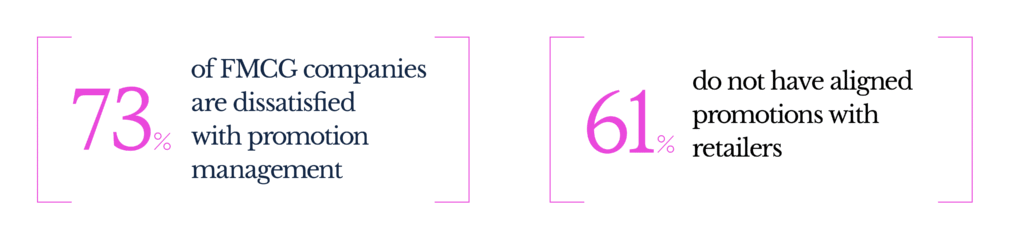
The new market norm is transparent, real-time execution of agreements between manufacturers, distributors, and retailers. Yet 73%* of CPG companies are dissatisfied with promotion management, and 61%* do not have aligned promotions with retailers.
However, if a planogram is approved, it must be executed in every store. If a promotion is launched, its impact must be measurable. Data must turn into actions — not remain checkmarks on a dashboard.
Fewer People — More Accountability
The global labor shortage, especially in frontline roles, is pushing the industry toward automation. However, the most expensive resource is not the hourly cost of field teams, but their time and effectiveness.
If people spend their time verifying photos, filling out checklists, and compiling endless reports, you are running a business from the past.
Today, AI can perform tasks that once required many field managers. Algorithms now handle operations in which cameras capture shelf layouts, and models analyze images. The system automatically assesses which tasks have been completed and which have not. By automating routine work, AI allows people to focus on more strategic tasks.
As a result, the same people can focus on what no model can replace: customer relationships, brand development, and strategy.
For example, automation for the “Rukavychka” retail chain saved 2.5–3.5 hours per store per month, or 550–770 hours per month for a network of 220 stores — translating into $4,400–$6,000 in monthly savings.
Speed of Change Is the New СPG Currency
Retail operates in constant motion, and technology allows companies to react and implement changes instantly. A new promotion or updated merchandising rules can be rolled out to thousands of stores overnight. This speed enables companies to adapt faster than competitors — creating an immediate advantage.
However, large organizations adopt change slowly. The best strategy is to start with what is safe: a mobile app, photo-based shelf verification, and transparent proof of execution. These deliver fast, visible results while minimizing risk, allowing clients to adopt innovation gradually.
For example, at Coca-Cola Beverages Ukraine, the launch of Effie resulted in a +15% increase in assortment presence and twice as many store visits completed according to plan.
AI Should Close the Loop — Not Start Another One
Most retail companies use AI only for product recognition on shelf photos. Technology can do much more. Years of work have enabled us to build a large-scale training dataset, achieving over 96% accuracy in shelf recognition. We handle complex cases, including soft packaging, visually similar products, and automatic price recognition, without prior training.
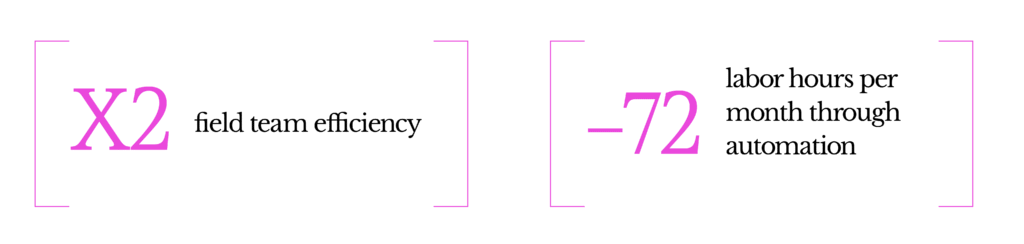
As a result, Snack Production achieved +11% sales in three months, doubled field team efficiency, and reduced 72 labor hours per month through automation. Bon Boisson saw +26% sales in the first month alone.
Modern language models can analyze store context and shopper behavior and immediately generate actionable recommendations or tasks. Instead of delivering a spreadsheet with recognized products, the system transforms data into clear actions.
A language model trained on company standards analyzes recognition results and provides tailored merchandising or improvement recommendations, considering each store’s specifics and assortment.
Based on these recommendations, tasks for field teams are automatically generated (e.g., “Move this product to position X”).
An Empty Shelf Is a Cultural Indicator, Not an Incident
An empty shelf is not only a lost sale — it is a signal that a company does not control reality. In a healthy culture, it triggers process improvement: Were standards communicated correctly? Did the store receive them? Were they feasible to execute? Did feedback return to headquarters?
Shelf reality matters more than reported reality, and true innovation begins when every agreement delivers measurable results.
The Future of Retail Is Not Without People — It’s Without Chaos
Global retail leaders are not looking for magic buttons. They seek predictability in execution, the ability to see, act, and trust. 72%* of promotions worldwide are unprofitable due to uncontrolled execution.
Technology creates a new management culture where order becomes the norm and accountability becomes a competitive advantage.
The future of retail is not about working faster — it is about working more precisely. And that future starts with a simple question:
“Was what we agreed on actually executed?”
Those who can answer “yes” and prove it with data will win. AI will become your ally to the extent that you are ready to entrust it with routine tasks and demand results from it.
* – Promotion Optimization Institute, State of Industry Report 2025
Related

10 Signs Your Execution Model Won’t Scale

Holiday Season in CPG: Key Signals After the Peak Weeks