How AI Agents Are Transforming Retail Execution for CPG


The CPG and retail landscape is evolving rapidly. Shoppers now expect seamless, personalized experiences, while brands face increasing pressure to keep shelves stocked, costs low, and execution flawless. Only a few years ago, AI was considered “future tech.” Today, it is a standard industry tool — and the data supports this shift.
According to the NVIDIA State of AI in Retail and CPG report:
- 89% of retailers and CPG companies are currently using or testing AI.
- 87% have seen tangible revenue gains.
- 94% report a reduction in operational costs.
Top use cases include inventory management, demand forecasting, shelf analytics, dynamic promotions, and adaptive pricing. As implementation accelerates, the real question is no longer whether to use AI, but how to apply it strategically.
This is where AI Agents come in: tools that go beyond data analysis, enabling brands to act faster, smarter, and at scale.
What Are AI Agents?
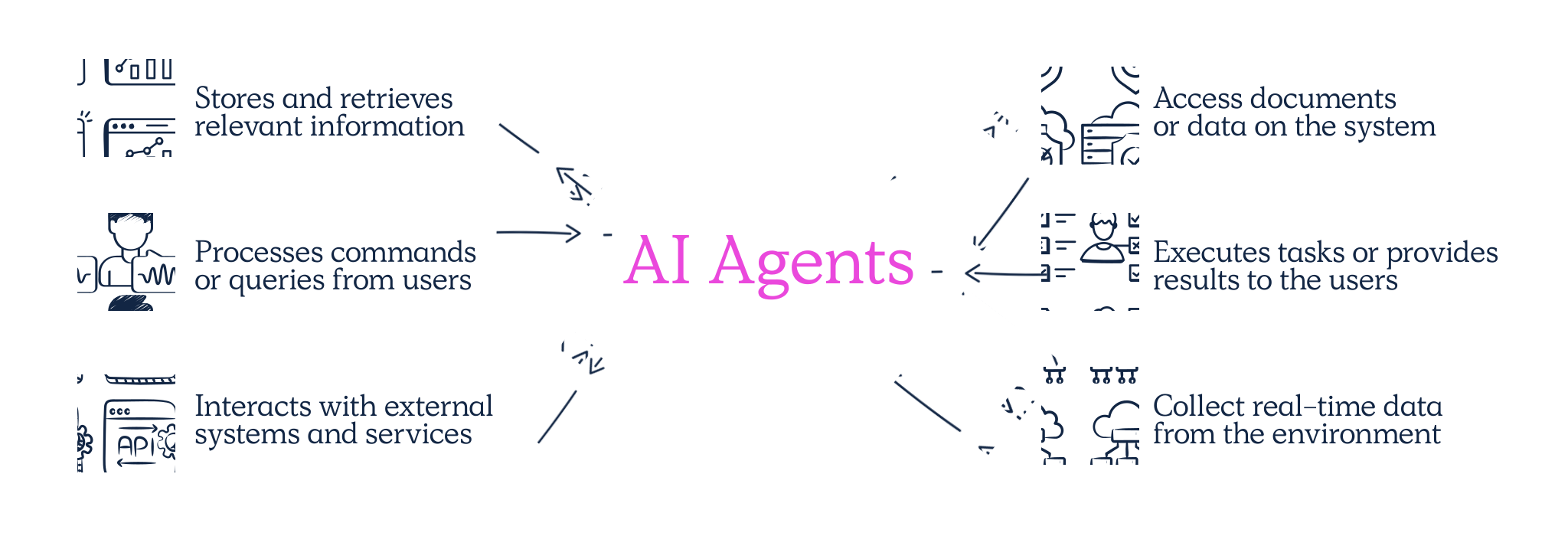
AI agents are autonomous systems that can monitor in-store conditions, analyze shelf or operational data, make decisions, and trigger actions with minimal human input. Essentially, an AI agent is an intelligence layer designed to achieve specific goals by utilizing tools. It can tap into multiple AI models, access internal and external systems on behalf of the user, and rely on persistent memory to maintain context across tasks.
Unlike traditional tools that only surface issues, AI agents recognize patterns, interpret what’s happening, and trigger corrective actions within a single, closed loop. For CPG brands, this means a shift from “we see the issue” to “the issue gets fixed in real time,” with agents making and executing decisions autonomously while humans stay in control of strategy, not manual checks.
Challenges in Implementing AI Agents
Despite the significant potential that AI agents offer for the transformation of the CPG sector, their effective deployment is associated with several serious obstacles:
- Data Fragmentation and Quality: Retail data originates from multiple partners, each using their own formats and quality standards. Ensuring the cleanliness, unification, and reliability of these disparate datasets for AI agent analysis remains one of the main technical hurdles.
- Significant Integration Costs: For mid-sized CPG brands, implementing AI agents for monitoring retail execution can be financially demanding. This necessitates a considerable investment in establishing data capture systems, model training, and integrating them into the workflows of field teams to acquire accurate shelf-level data.
- Change Management and Training Needs: Integrating AI solutions into existing operational processes requires careful change management. Proper staff training, fostering a culture that supports technology, and establishing cross-functional coordination are essential to ensure a smooth and complete adoption.
- Regulatory Compliance and Privacy: As AI agents collect large volumes of shelf status and behavior data, companies must strictly adhere to regional and international data protection and privacy standards to prevent unauthorized use or information leaks.
However, the rewards of AI adoption far outweigh these roadblocks. The key is choosing partners who offer reliable, scalable, and easy-to-integrate solutions.
What Are the Types of CPG AI Agents?
- Shelf Intelligence Agents — these agents turn shelf photos into clear facts: which products are available, how they are placed, and whether prices and promotions are visible as planned. They help both manufacturers and retailers see what is really happening in-store, using simple metrics like on-shelf availability, number of facings, price accuracy, and promo presence.
- Retail Execution Agents — these agents show where execution is off-track and what should be done first. They highlight the stores and SKUs with the biggest gaps versus plan and create prioritized visit lists and action plans for field and sales teams.
- Insight and Optimization Agents — these agents analyze execution and sales results over time to show what actually works. They compare different promotions, displays, and shelf strategies and recommend where to invest more, what to change, and what to stop doing to improve ROI.
- Predictive Foresight Agents — these agents warn teams about problems before they hurt sales. They identify patterns that typically lead to stockouts or poor compliance and suggest proactive moves, such as adjusting inventory, refreshing displays, or scheduling extra store checks.
- Unified Execution Intelligence Agents — these agents act as the “single source of truth” for execution and sales performance. They consolidate shelf images, retailer data, POS, and commercial plans into one coherent view, helping cross-functional teams avoid conflicting reports and make faster decisions.
From AI Agents to Real-World Impact: Effie AI Merchandising Agent
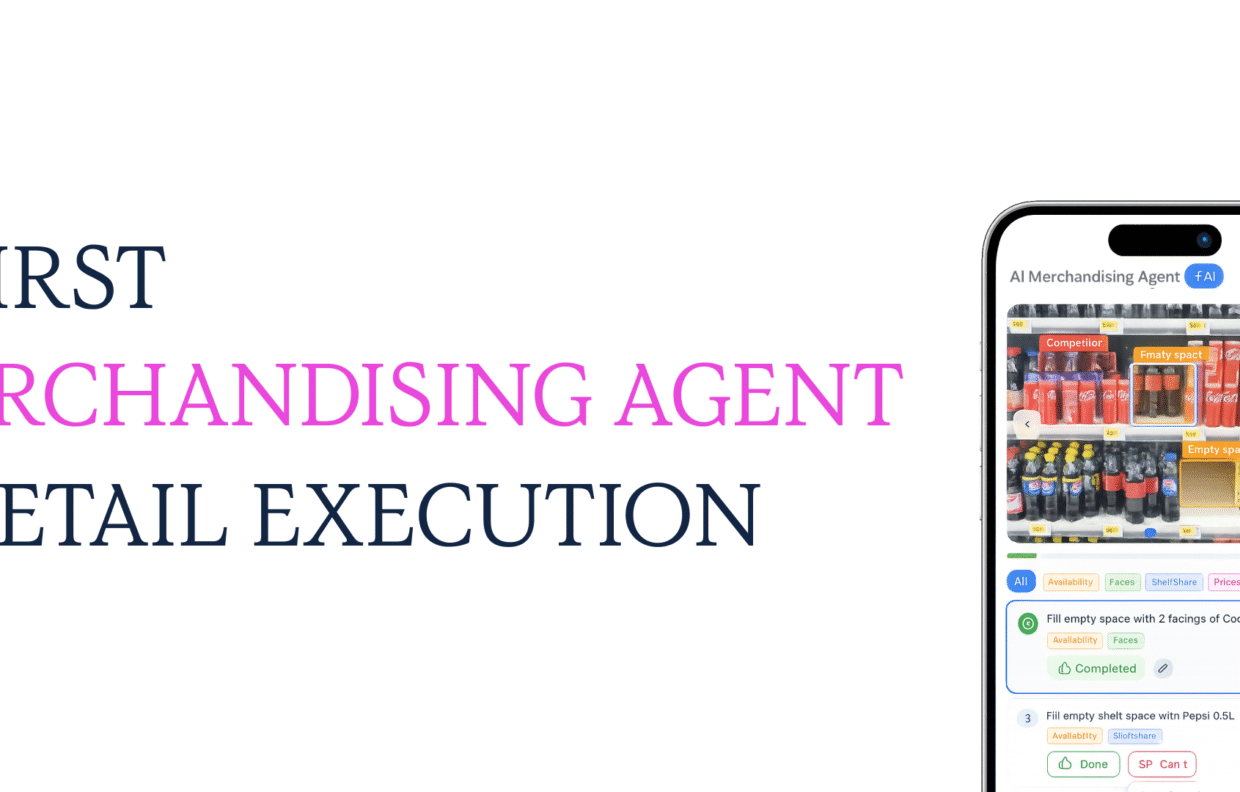
Effie AI Merchandising Agent turns retail execution from static reporting into an always-on, closed-loop workflow. It combines shelf intelligence, retail execution, and predictive insights into a single guided experience for field teams.
Instead of stopping at “what’s happening on the shelf”, effie translates every insight into concrete tasks, priorities, and checklists that merchandisers follow in-store.
With full shelf visibility across every outlet and consistently executed standards — even with new or rotating merchandisers — CPG brands cut time per store visit by up to 49% while improving compliance.
Why the effie AI Merchandising Agent stands out
- Single workflow: planograms, instructions, priorities, and checklists — all in one guided flow.
- AI Image Recognition: automatic detection of On-Shelf Availability, facings, displays, and promo compliance.
- AI Shelf Adjustment Playbook: step-by-step instructions to align the shelf to the planogram — like GPS, but for merchandising.
- Full, automated reporting: real shelf conditions with zero manual errors.
Why AI Agents Matter Now
For consumer goods companies, the message is clear: without an explicit AI-first roadmap for retail execution, brands risk falling behind competitors who are already redefining how work gets done in stores. Leaders are no longer just testing isolated use cases; they are rethinking workflows — from shelf intelligence and field execution to commercial planning — creating roles where human evolution and AI agents work together to make faster, smarter decisions.
Those who fully commit to this AI-driven model gain a structural advantage. They allocate focused resources to AI, empower teams to deploy agent-based solutions with real autonomy, and turn fragmented execution data into a single, actionable view. Instead of relying on manual checks and reactive fixes, they can redirect time and savings into brand building, innovation, and retailer partnerships — becoming more resilient, agile, and relevant in a highly competitive retail environment.
Ready to See AI in Action?
Email us at sales@effie.ai, and our team will reach out to show how the effie AI Merchandising Agent can help you achieve your goals.
Related

AI Merchandising Agent vs. AI Image Recognition

Overview of CAGNY 2026