From Shelf Images to Action: AI Image Recognition for CPG Execution


Despite digital transformation, CPG retail execution still relies on manual processes that don’t scale, slow decisions, and increase business risk. Field teams collect large volumes of in-store data, including shelf images, but this data is typically reviewed after the visit for reporting rather than used to drive action in the moment. This delay creates a gap between real shelf conditions and management response. Closing this execution gap has become critical to improving operational effectiveness.
The Execution Gap in CPG: Where Sales Are Lost
For CPG companies, in-store execution often determines whether strategy translates into actual sales. Even with the right assortment and promotions in place, shelf-level results frequently fall short of expectations.
Sales are lost in operational details — out-of-stocks, incorrect placement, pricing errors, inactive point-of-sale materials — factors that directly influence shopper choice but are difficult to control consistently at scale.
The core challenge is speed. Information about shelf conditions reaches teams with a delay, when the situation in the store has already changed and influencing the outcome is no longer possible.
Why Traditional Shelf Audits No Longer Scale
Today, CPG brands operate with hundreds of SKUs, complex planograms, and retailer-specific requirements. Under these conditions, manual shelf audits become slow, highly dependent on human judgment, and structurally unstable at scale.
In addition, shelf data typically reaches systems after the store visit has ended. This makes it useful for control and reporting but is insufficient for managing execution at the moment.
This is where AI Image Recognition approaches emerge — addressing the limitations of manual processes by transforming shelf images from a documentation tool into a source of fast, objective, and scalable action.
What AI Image Recognition Means for CPG Execution
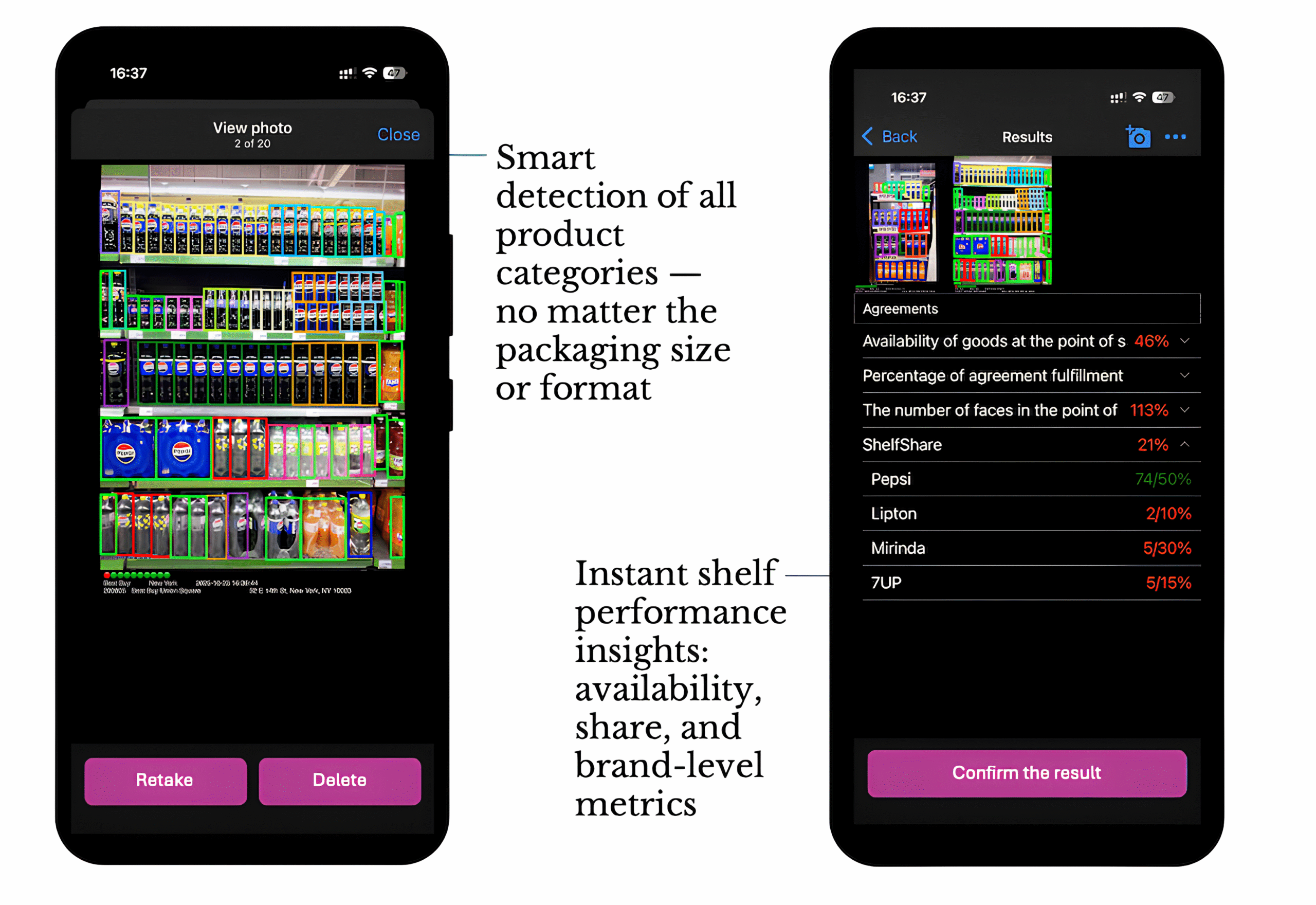
AI Image Recognition is a technology that enables automated analysis of visual data and the identification of objects within images. It detects products, packaging, logos, price tags, text, and their placement within a single image.
In the context of retail execution, the technology is used to monitor shelf conditions — verifying product availability, placement accuracy, and compliance with execution standards, including planograms and promotional requirements. Automated analysis reduces reliance on manual audits, shortens data collection cycles, and delivers timely, reliable visibility into shelf conditions.
How AI Image Recognition Works
AI Image Recognition is designed around rapid data capture and processing so decisions can be made during the store visit itself.
- In-store visual data capture
Shelf images are captured in-store, reflecting the actual state of products, prices, and promotions at a specific moment in time. - Automated processing and classification
Images are analyzed automatically to identify products, placement, pricing, and other execution-relevant elements. - Automated comparison against standards
Extracted data is matched against planograms and execution requirements, instantly identifying deviations. - Real-time action recommendations
Based on the analysis, the system generates clear guidance on what needs to be corrected in that store — immediately.
The key value of this approach is speed. What previously took hours or days is reduced to seconds, minimizing the distance from image to decision.
In practice, AI Image Recognition enables a defined set of shelf-level execution controls that can be monitored and acted on consistently across all stores:
| Functionality | How It Works | Key Outcomes |
| On-Shelf Availability (OSA) | Checks for the presence of specific target SKUs defined in the assortment matrix. | Provides a binary “Yes/No” status for each item, ensuring core assortment compliance. |
| Assortment List Compliance | Filters recognition results against specific high-priority lists (e.g., “New Arrivals,” “Top SKUs”). | Calculates the execution compliance rate for critical product lists. |
| Facing Count | Detects and counts every visible unit of the client’s SKUs while identifying competitor products as generic category objects. | Delivers precise data on brand visibility and shelf saturation. |
| Share of Shelf (SOS) | Calculates the brand’s percentage share relative to the total category volume (client SKUs vs. all shelf SKUs). Supports defining “recognition zones” to isolate specific shelf sections. | Delivers objective metrics on actual category share, validating whether the brand secures its targeted physical shelf space. |
| Price Monitoring | Reads regular prices from tags associated with on-shelf products and compares them against recommended retail prices (RRP). | Highlights pricing deviations and validates compliance with pricing strategies. |
| Promotion & Promo Price Tracking | Validates the presence of active promotions by identifying promo-specific tag types (color/design) and comparing the recognized price against the authorized campaign price. | Alerts on missing promotions (e.g., regular tags found instead of promo tags) and identifies price discrepancies. |
The Benefits of AI Image Recognition
AI Image Recognition shifts the role of data in retail execution — from a control mechanism to a driver of in-store action. For CPG companies, this delivers tangible business impact beyond automation.
- Execution speed — shelf analysis takes seconds, not hours or days
- Accuracy and objectivity — consistent data quality without human bias
- Lower operational costs — reduced manual audits and post-processing
- Unified execution standards — consistent evaluation across all stores
- Scalability — easy rollout across thousands of locations
Effie AI Image Recognition: From Data to Action
Effie AI Image Recognition transforms shelf management from static reporting into a continuously active, closed-loop execution process.
It combines image recognition, shelf analytics, and action recommendations, so shelf data is used during the visit — not after it.
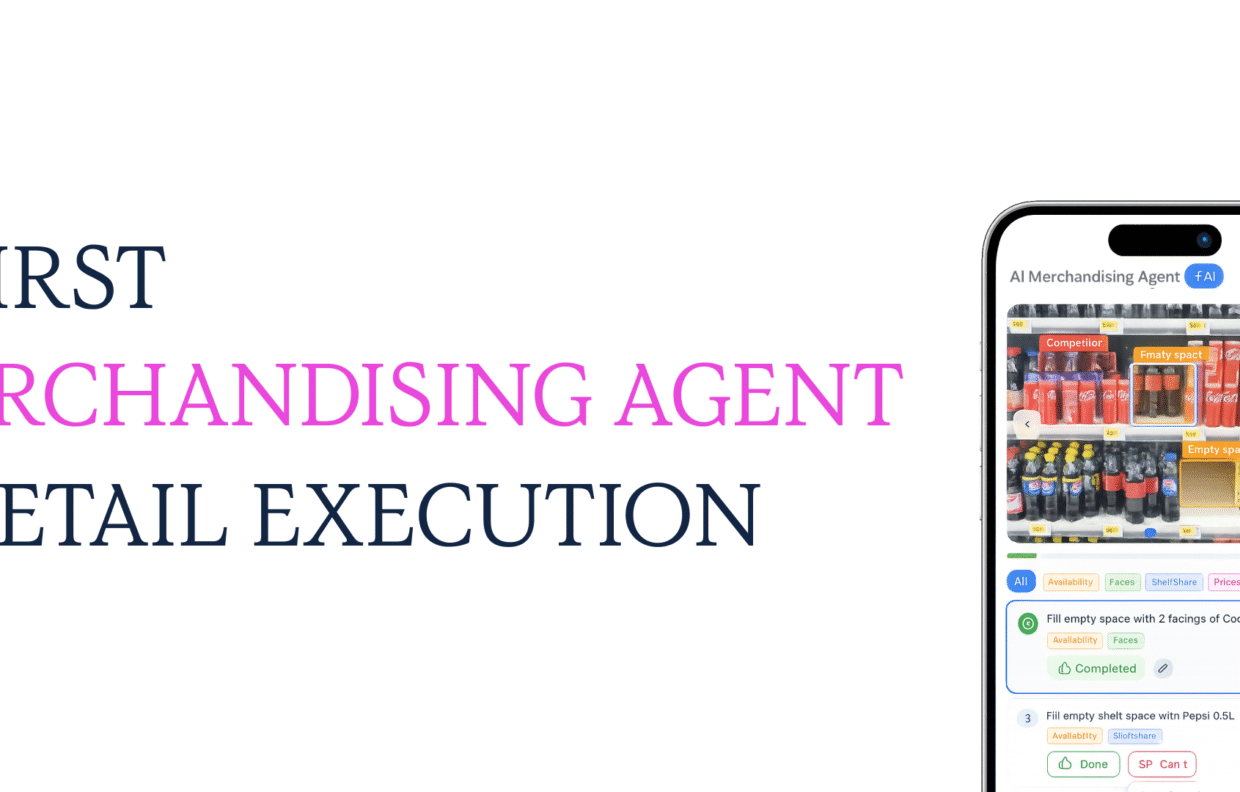
Rather than stopping at “what’s happening on the shelf,” effie translates every insight into Next Best Actions — concrete steps that can be taken in that store, at that moment.
Why effie image recognition stands out:
- 3 seconds from image to data — execution-ready insights without delay
- Over 95% recognition accuracy (based on internal effie measurements on real shelf images)
- On-device and cloud processing — flexible performance across store conditions
- Full shelf coverage — automated recognition of SKUs, prices, POSM, and competitors
- Execution-level analytics — planogram compliance, Perfect Store, and Shelf Share in a single model
- Action-driven approach — Next Best Actions instead of retrospective reports
Conclusion
For CPG brands, effective in-store execution has become a primary growth driver. When shelf management relies on manual processes and delayed data, brands lose speed, control, and sales.
AI Image Recognition closes this gap by turning shelf images into accurate, action-ready insights in real time. This approach enables CPG teams to scale execution, reduce losses, and ensure consistent standards across every store.
To learn how AI Image Recognition can be applied in your stores, contact us at sales@effie.ai.
Related
AI Merchandising Agent vs. AI Image Recognition

Overview of CAGNY 2026