
AI Merchandising Agent vs. AI Image Recognition


Detector vs. Operator in Retail Execution
Retail execution has long struggled with a fundamental gap: companies can now clearly see what’s happening in-store with AI Image Recognition, but they still struggle to act at the moment that matters most – at the shelf, when the issue is detected. Seeing is not enough.
This is where the difference between AI Image Recognition and an AI Merchandising Agent becomes critical.
At its core, the distinction is simple — yet transformative:
- AI Image Recognition is a detector
- AI Merchandising Agent is an operator
Technology Role in the Retail Execution Flow
To understand the difference, we need to look at how each technology performs during a real store visit, where the fundamental tasks of a merchandiser happen.
A typical visit includes:
- Understanding store requirements
- Checking shelf conditions
- Identifying issues
- Deciding what to fix
- Executing tasks
- Reporting back to HQ
AI Image Recognition: Strong at Detection
AI Image Recognition plays a critical role in one part of this flow understanding shelf reality. During the visit, it:
- Captures shelf images
- Detects SKUs, facings, and displays
- Identifies out-of-stocks and compliance gaps
It answers: “What is wrong on the shelf?”
This makes it a powerful detector, fast, objective, and scalable. However, its role typically stops here.
It does not:
- Combine this insight with business priorities
- Guide the merchandiser on what to do next
- Ensure execution actually happens
The Gap: Detection Without Operation
Even with perfect detection, execution still depends on the human:
- Interpreting results
- Remembering planograms and agreements
- Deciding next best steps
This leads to:
- Inconsistent execution
- Slower visits
- Dependence on individual experience
- Lost sales opportunities
In other words: the system sees — but does not act.
AI Merchandising Agent: Operating the Visit
An AI Merchandising Agent operates across the entire execution flow, not just detection. It transforms retail execution from a measurement process into an action system.
During the visit, it:
- Understands the Store Context: Consolidates requirements from multiple sources
(agreements, planograms, priorities, instructions)
- Detects the Reality: Uses AI Image Recognition to analyze the shelf in real time
- Decides What Matters: Prioritizes issues based on business impact
- Guides Execution: Generates a complete, store-specific action plan and provides step-by-step guidance to the merchandiser
- Verifies Instantly: Confirms that issues are fixed during the visit
- Reports Automatically: Sends results directly from shelf to HQ dashboards
It answers a fundamentally different question: “What should be done right now — and how exactly to do it?”
Detector vs. Operator
| Role in Execution | AI Image Recognition | AI Merchandising Agent |
| Role | Detector | Operator |
| Understand shelf | ✅ | ✅ |
| Detect issues | ✅ | ✅ |
| Guide step-by-step | ❌ | ✅ |
| Execute via field | ❌ | ✅ |
| Verify during visit | ❌ | ✅ |
| Close the loop | ❌ | ✅ |
Detection is necessary. Operation is what drives results.
From Open Loop to Instant Closed Loop
AI Image Recognition improves visibility.
AI Merchandising Agent creates an Instant Closed Loop:
Detect → Understand → Decide → Correct → Verify — in real time
This eliminates the delay between:
- Insight and action
- Field and HQ
- Problem and resolution
And delivers measurable impact:
- Up to 56% reduction in visit time
- 30% reduction in out-of-stocks
- +6% on-shelf availability
- 2–4% sales uplift
AI Image Recognition enables companies to see what’s happening in-store. AI Merchandising Agents enable organizations to act on it instantly and correctly.

Overview of CAGNY 2026
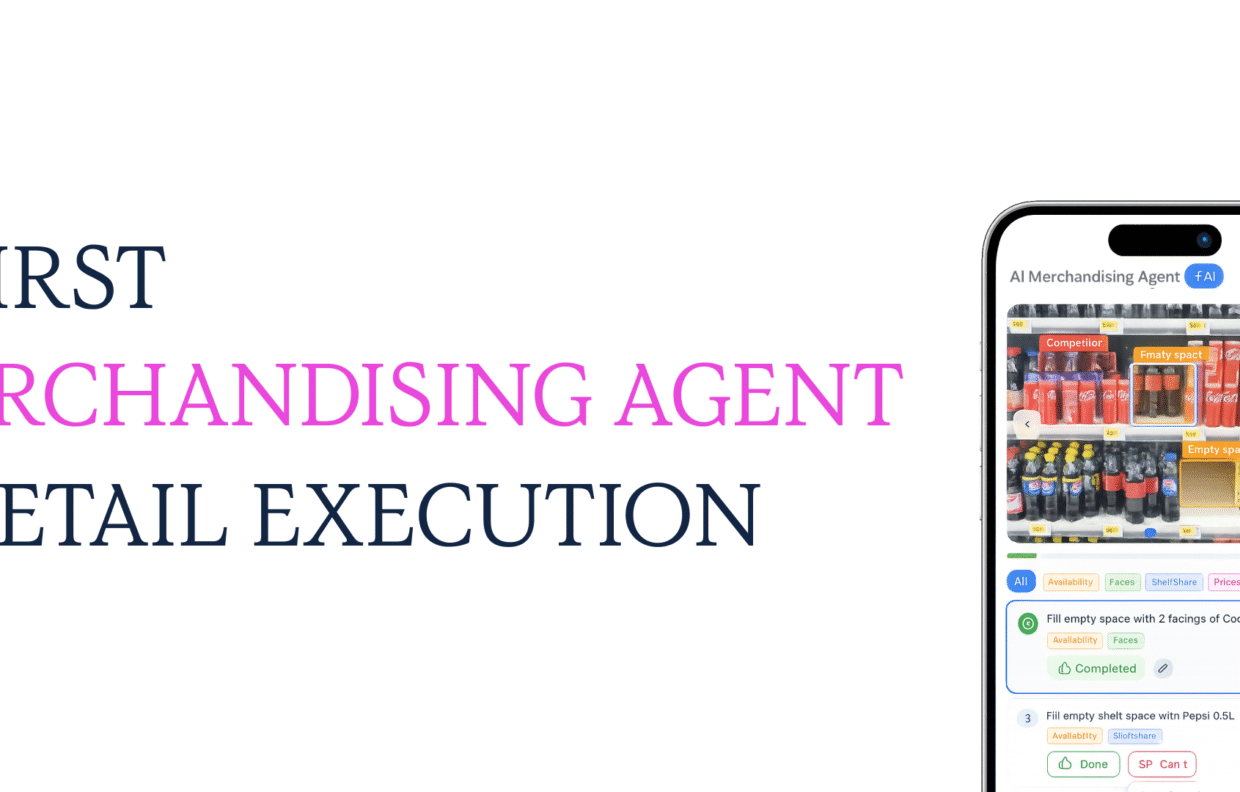
Effie.ai Launches the First AI Merchandising Agent for Retail Execution.